
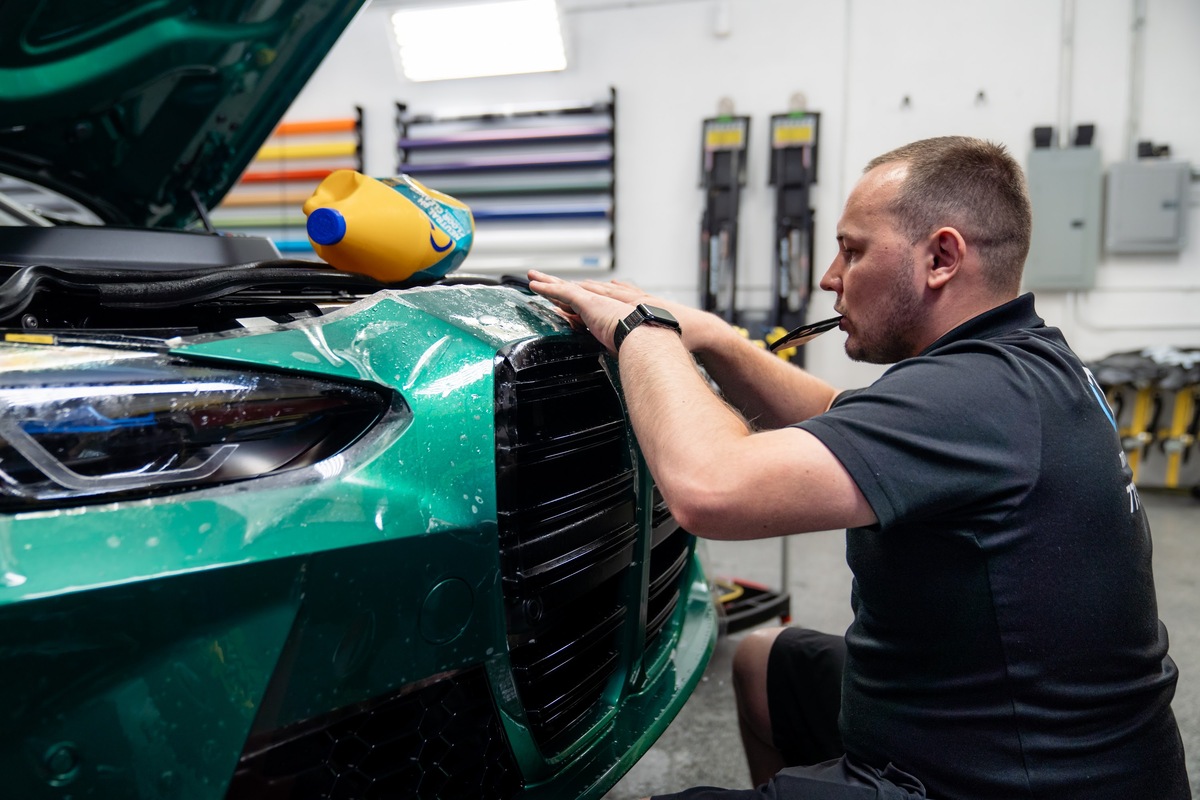
At PPF WRAP, a great paint protection film installation is supposed to be hard to notice. Behind that result is a Chicago operation built around preparation, installer judgment, quality control, and a willingness to redo work when a panel is not right.
At Loc8NearMe, we’re starting Local Stories Near Me — a new interview series with local professionals — people who know their cities not from a map, but from years of working in them.
The goal is simple: support strong local businesses and give readers a closer look at the people, experience, and know-how behind the services they rely on every day.
For this edition, we spoke with Alex Belov, General Manager of PPF WRAP in Chicago, about what separates an average paint protection film installation from one that still looks right after months of real driving, winter weather, road salt, washing, and daily use.
The Work That Is Supposed to Disappear
Paint protection film has an unusual standard for craftsmanship: the better the installation, the less attention it should call to itself.
Belov says delivery day can be misleading. A freshly cleaned vehicle under bright shop lighting may make many installations look acceptable. The differences show up later, after the car has been washed, driven through different weather, and returned to normal use.
A strong installation should still have secure edges, no trapped debris, no obvious stretch marks, and no corners beginning to lift. From a normal viewing distance, the film itself should be difficult to notice.
“If the customer has to search for where the film begins and ends, then we must have done our job right,” Belov says.
That is especially relevant in Chicago, where a vehicle may leave a clean shop floor and soon be dealing with highway debris, salt, slush, and repeated temperature changes.
Why PPF Became Its Own Business
PPF WRAP grew out of Tinting Chicago, where the team had already spent years working with vehicles before deciding paint protection film needed a dedicated operation.
The reason, Belov says, was that PPF required a different level of preparation and hands-on experience. Film behaves differently depending on the vehicle, the panel, the paint condition, the curve, and the amount of tension involved.
The team had also seen rushed installations elsewhere: exposed edges, visible lines, poor finishes, and film that did not hold up as expected.
Rather than keep PPF as another service on a broader menu, they built a separate process around it — trained in-house installers, controlled workspaces, computer-cut patterns, careful preparation, and a final quality check on every vehicle.
PPF WRAP now operates through four Chicagoland installation centers, with two locations in Chicago and additional locations in Palatine and Naperville.

Learning From the Jobs That Did Not Go Perfectly
Some of the most useful lessons came from edges.
Belov describes problems the team encountered over time: film lifting, visible lines on tight curves, seams that did not sit correctly on more complicated panels.
Instead of treating each problem as an isolated repair, the team began documenting what happened and discussing why.
They compared how different films reacted to difficult shapes and what changed when the installation method changed. The goal was to stop knowledge from remaining with whichever installer happened to encounter the problem first.
“If we run into a problem, we don’t want the lesson to stay in one installer’s head,” Belov says. “We want the whole team to learn from it and improve the procedure. Every mistake should make the next installation better.”
That approach says more about the shop than a generic claim about craftsmanship. Individual experience becomes part of how the next vehicle is handled.
Where Process Ends and Judgment Begins
Computer-cut patterns provide consistency, but they do not remove the need for an experienced installer.
Every vehicle has its own geometry and paint condition. The film still has to be read and adjusted in real time.
PPF WRAP standardizes the steps around that judgment: inspection, preparation, positioning, edge work, curves, and the final panel check. More experienced installers work alongside newer team members, passing on techniques learned through difficult jobs.
Belov says new installers begin with preparation, film behavior, tool use, and clean working habits before moving on to bumpers, mirrors, complex curves, and larger panels.
Technical skill comes with repetition. The harder part is learning when something is not right and stopping before a small issue becomes part of the finished job.
That kind of judgment is difficult to teach from a manual alone.
The Second Set of Eyes
Quality control at PPF WRAP does not begin only when the car is finished, but there is a separate final check before the vehicle is released.
Another member of the team reviews the installation.
Belov says that matters because after spending hours on the same vehicle, an installer can become too familiar with the work and miss details that someone seeing it fresh will notice immediately.
Under high-intensity lighting, the team checks edges, seams, corners, and difficult curves. They look for lifting, trapped debris, bubbles, wrinkles, stretch marks, and anything else that appears wrong when viewed closely. The vehicle is examined from multiple angles rather than given a quick walk-around.

When a Panel Has to Be Redone
Detailed installation creates an obvious conflict with shop capacity.
The more time spent correcting one vehicle, the fewer vehicles can be completed that day.
Belov’s rule is simple.
“If a panel isn’t right, it gets redone,” he says. “I’d rather lose a few hours than hand over something I already know isn’t right. The schedule has to serve the quality standard, not the other way around.”
The shop limits how many vehicles it takes on at once for the same reason. Difficult panels are allowed to take longer, and work is redone when necessary.
A customer may never know how much extra time went into correcting a panel before delivery. That is preferable to them noticing later that the shop chose not to.
Chicago Changes the Recommendation
Local conditions play a direct role in how PPF WRAP recommends coverage.
Chicago winters mean salt, grit, slush, debris, and repeated temperature changes. Drivers who spend a lot of time on local highways also put the front of the vehicle in the path of constant road debris.
Belov says that does not mean every vehicle needs full-body PPF.
A driver mainly concerned with the most exposed areas may be better served by partial-front protection. Someone doing more highway driving may choose full-front coverage, while full-body PPF makes more sense for drivers who want broader protection.
“There is no one-size-fits-all package,” Belov says.
That combination of local experience, installation standards, and customer feedback has helped position PPF WRAP as one of the best PPF shops in Chicago and the surrounding suburbs.
Its Loc8NearMe profile currently shows a 5.0 rating from 56 reviews, with customers specifically mentioning clean seams, wrapped edges, precise cuts, and film that is difficult to see once installed.
The company also reports more than 2,500 Google reviews across its operation and publishes installer-level experience metrics, including thousands of hours of hands-on work and substantial volumes of film installed across different vehicles and panel types.
PPF WRAP works with established film brands including XPEL, 3M, LLumar, SunTek, STEK, and Avery Dennison. Belov says the choice depends on the vehicle and the balance of cost, performance, and coverage the owner is looking for.
Those numbers alone do not determine who is the best PPF installer in Chicago. What they do show is why PPF WRAP has become one of the area’s more established paint protection film specialists: multiple local locations, a large review footprint, experienced installers, dedicated PPF processes, and a quality-control system that includes another person checking the finished work.
More importantly, the local knowledge affects the recommendation itself.
In Chicago, selling every customer the maximum amount of film would be easy. Knowing which areas of a particular vehicle need protection based on where and how its owner drives is more useful.
The Work Before the Film
Ask Belov which stage of an installation is most important and he points to preparation.
“Preparation is probably the most important of all.”
The surface has to be thoroughly cleaned and decontaminated. Edges, panel gaps, trim, and other areas where contamination can create problems later receive extra attention.
The paint condition is also checked before installation. If correction is needed, or existing damage could affect adhesion or the final appearance, it has to be addressed before the film goes on.
Then there are the details that take time but disappear into the finished result: getting a clean edge on a complicated curve, making a seam look natural, or changing the approach when the film is not sitting correctly.
“The odd thing concerning good PPF work is that some of its most important aspects are exactly those which the customer never sees,” Belov says.
What a Day Inside the Shop Reveals
This is a new Paragraph block. Change the text.